How to Compare Electronics Manufacturing Services in Poland – PCBA Price vs. Total Production Cost
Price is one of the key criteria when selecting an electronics manufacturing supplier. For companies looking for electronics manufacturing services Poland, the first parameter that is often compared is the cost per PCBA unit. This is confirmed by data from a report on customer expectations towards EMS providers: as many as 90% of respondents identified service price as an important factor when selecting a supplier. At the same time, 83% of customers expect an EMS provider to combine low prices with high quality.
However, the final PCBA price depends on much more than component assembly alone. The calculation may include components and PCB, SMT and THT assembly, production preparation, NPI and NRE, testing and quality control, programming, coating, potting, Box Build, purchasing and sourcing, packaging, logistics, and activities related to ensuring supply continuity.
Differences between quotes may also result from a different scope of services, level of automation, process safeguards, or division of responsibilities between the EMS provider and the customer. Therefore, when comparing quotes from electronics manufacturing services providers in Poland, it is worth analysing not only the price of one PCBA, but also exactly what is included in it, which responsibilities remain with the customer, and what additional costs may arise during project execution.
What Makes Up the Price of a PCBA in Electronics Manufacturing Services?
The price of a PCBA is not determined solely by the cost of assembling components onto the board. The final quotation may include materials, production preparation, assembly, quality control, testing, additional operations, and delivery arrangements.
The importance of each element depends on the board design, product requirements, production volume, and scope of responsibility taken on by the EMS provider.
Before Production
Components are particularly important – their number, specifications, availability, and purchasing source affect not only material costs, but also the ability to maintain production over the long term. Component selection should take into account both technical requirements and availability, as well as risks associated with the product life cycle.
Production preparation also affects the price, including NPI and NRE costs. These may cover, among other things, preparation of production documentation, machine programs, fixtures and tooling, preparation of test stations, and activities related to production launch.
The amount of NRE depends primarily on project complexity, the technologies used, and the scope of work required to start production. These costs can be optimised, among other things, through proper documentation preparation, the use of existing tooling and test stations, and appropriate NPI planning.
It is also worth considering NRE in relation to the entire project and planned production volume. A one-off cost spread over a larger number of units has a much smaller impact on the unit PCBA price.
PCB Assembly
Another important component of the price is the PCB and component assembly. The cost of the board depends, among other things, on its dimensions, number of layers, laminate type, technological parameters, surface finish, and manufacturing requirements. The PCB unit cost is also affected by order quantity.
The assembly technology itself also has a direct impact on price. Electronics manufacturing primarily uses SMT (Surface Mount Technology) and THT (Through-Hole Technology).
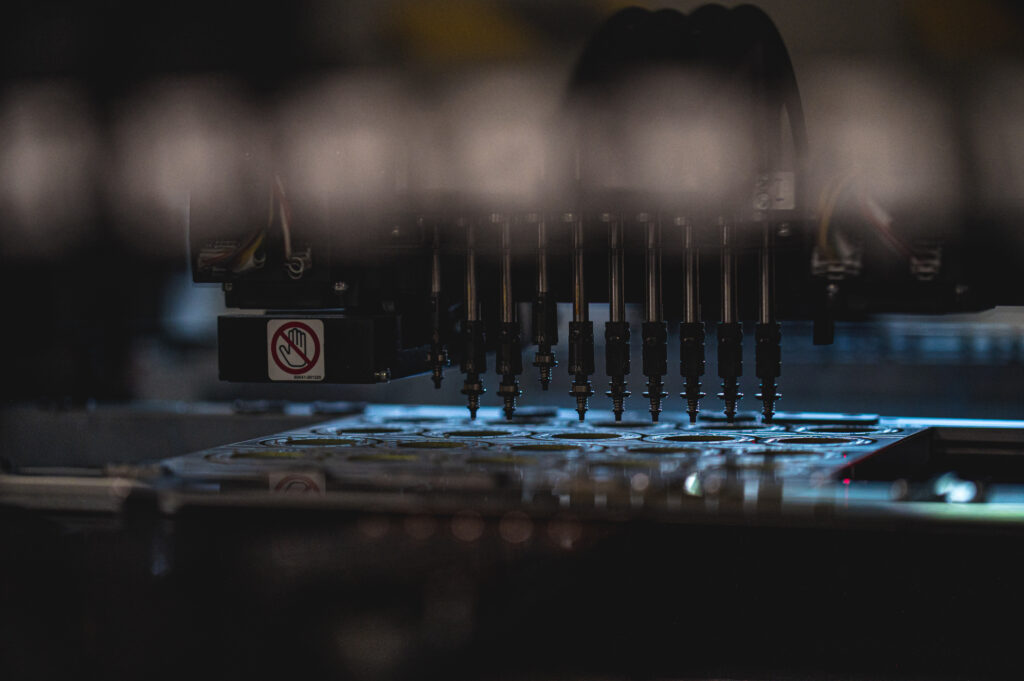
SMT involves placing components directly onto the surface of the PCB. Through automation, it enables fast assembly of large numbers of components and the use of small components with high component density on the board. Process costs are affected, among other things, by the number and type of components, the number of different component types, and the complexity of the board. At sufficiently high volumes, a high level of automation can significantly reduce the cost of mounting an individual component.
In THT assembly, component leads pass through holes made in the PCB. This technology is used, among other things, for components requiring additional mechanical strength, such as certain connectors, switches, or larger components. Part of the process can be automated, while some components require manual assembly.
The assembly technology is determined primarily by the design and intended use of the device and by the characteristics of individual components. Therefore, the scope and method of assembly should be determined based on the requirements of the specific project, rather than solely on the expected unit price.
Quality Control and Testing
The scope of PCBA quality control and testing also affects the price. It should correspond to the board design, components used, and requirements concerning the reliability of the finished product.
Quality control may include SPI, AOI-3D, X-Ray inspection, as well as electrical and functional tests such as ICT, FCT, or EOL. Individual methods detect different types of non-conformities, so it is not always necessary to use all of them. What is important is to select control points appropriately for the potential risks present in a particular project.
SPI makes it possible to control solder paste application quality before components are placed. AOI-3D automatically checks, among other things, the presence, position, and solder joints of components, also taking height information into account. X-Ray is used to inspect connections that are not visible from the board surface, for example under BGA packages. ICT and FCT, in turn, allow specified electrical parameters and the operation of the circuit to be checked.
The scope of testing increases production costs, but it can also reduce the risk of defective PCBA being passed to the next production stage or to the customer. Therefore, the cost of inspection should be analysed in relation to the potential consequences of failing to detect a non-conformity.
Additional Services and Delivery
For more complex products, operations performed after assembly are also added to the PCBA cost, such as programming, coating, or potting. Applying a protective coating may be required due to environmental conditions, while potting is used in projects where additional protection against moisture, contamination, vibration, or external interference is important.
An even broader scope of work is covered by Box Build, where production does not end with delivery of the PCBA itself. The service may include mechanical assembly, integration of the board with the enclosure, wiring and other components, programming, testing, and preparation of the complete device for shipment. In such a case, the price refers not only to electronics assembly, but to the entire product integration process.

Purchasing and sourcing of components, packaging, and logistics also affect the final calculation. The scope of these activities may vary depending on the cooperation model – some tasks may be taken over by the EMS provider, while others may remain with the customer.
Price vs. Batch Size – When Does Scale Really Reduce Cost?
Batch size can have a significant impact on unit cost, but not all cost elements decrease as volume increases.
A larger production run may improve component purchasing terms, facilitate planning, and allow production preparation costs to be spread over a larger number of units.
Ad hoc orders placed without forecasts or information about longer-term demand limit opportunities to optimise costs. Sharing a broader production plan with the EMS provider can facilitate order consolidation, help secure better prices and enable earlier responses to potential shortages of critical components.
If production preparation costs PLN 20,000 (of which NRE is PLN 19,000 and the cost of launching the batch is PLN 1,000), for a single batch of 500 units this corresponds to PLN 40 per unit. For 10,000 units, it is already PLN 2 per unit. As volume increases, the unit cost of production preparation therefore falls significantly.
At the same time, a larger production run does not always mean a lower total cost. MOQ, batch launch costs, order frequency, inventory levels, and the risk of being left with material or finished products if demand changes or a component is discontinued must also be considered.
Therefore, when planning production, it is worth analysing not only the size of an individual order, but also delivery frequency, expected volume over the entire product life cycle, and inventory level.
Purchase Price vs. Total Production Cost in Electronics Manufacturing Services Poland
The unit PCBA price is one of the easiest quotation parameters to compare. However, it does not show all the costs associated with project execution.
Therefore, when evaluating a quote, it is worth taking a broader view of TCO (Total Cost of Ownership), meaning the total cost associated with implementing and maintaining a given production model. In electronics manufacturing, this may include not only the PCBA purchase price, but also NRE and batch launch costs, components, testing, logistics, storage, purchasing support, engineering changes, quality, and activities related to maintaining supply continuity.
TCO makes it possible to view an offer from the perspective of the entire process, rather than just an individual item on an order. It is particularly important when two quotes have different scopes of service or allocate responsibilities and costs differently between the parties.
At this stage, it is worth distinguishing three related but different categories.
TCO describes the broad economic cost of a given production model.
Opportunity cost shows the additional resources and costs resulting from the chosen way of organising the process. These may include, for example, the customer’s employees’ time required for sourcing, logistics, quality control, or inventory management.
Risk cost concerns the potential consequences of events that may disrupt production, deliveries, or project execution. It does not necessarily materialise, but its significance depends on the probability of the event and its potential consequences.
These three perspectives make it possible to move from the simple question “How much does the PCBA cost?” to a broader question: how many resources and costs are required to ensure production at the required volume, quality, and delivery time?
What May Be Behind a Very Low Price?
A low PCBA price does not in itself mean lower quality or poorer project execution. It may result from economies of scale, a high level of automation, a well-optimized process, favorable purchasing conditions, or a well-planned supply chain.
Another challenge lies in how prices are calculated. EMS providers may include different cost items in their unit prices, such as sourcing, testing, logistics or production preparation. Some items may be quoted separately or remain the customer’s responsibility. Before comparing offers, it is therefore worth clarifying with each provider exactly what the quoted price covers and how additional costs are charged.
However, if the difference between the quotes being compared is significant, it is worth checking exactly what causes it. The offer may be lower because the manufacturer organises production and purchasing more efficiently, but the difference may also result from a different scope of service or a different division of responsibilities between the EMS provider and the customer.
Before comparing the figures themselves, it is therefore necessary to make sure that both offers cover the same components, assembly technology, scope of inspection and testing, additional operations, delivery terms, and manufacturer responsibilities.
The figure shown under “PCBA price” therefore does not always describe a comparable product or service. Only a comparison of the scope of both offers makes it possible to determine whether the difference results from process efficiency or from a different scope of service.
Opportunity Cost – What Responsibilities May Remain with the Customer?
Not all production-related costs are paid directly to the EMS provider. Some tasks may remain with the customer, which means additional involvement from its team.
This includes, among other things, component sourcing, transport organisation, inventory management, coordinating changes, quality control, and handling problems. If these tasks are not performed by the EMS provider, this does not mean they are no longer necessary. They may simply be transferred to OEM employees.
Logistics and Delivery Time
One example is electronics manufacturing on another continent. The transport cost itself is not always the biggest issue. The total time required to move products between the factory and the customer’s facility may be more significant.
A logistics chain spanning many thousands of kilometres involves a greater number of stages that need to be taken into account when planning. In addition to production time, there are transportation, customs clearance, transshipment, shipment consolidation and potential delays. Last but not least, production on another continent makes the delivery schedule additionally dependent on sea or air freight. In turbulent times like these, this may mean the need to take much longer alternative routes, doubling costs and further increasing delays.
Therefore, when comparing offers from electronics manufacturing services providers in Poland and other locations, it is worth distinguishing production time from total lead time. A manufacturer may declare a short PCBA production time, but if there is a long transport route between the factory and the customer, the actual time from order placement to receipt of the product will be correspondingly longer.
A longer supply chain may also mean the need to maintain a larger safety stock. The inventory then needs to cover not only normal demand, but also potential delays.
Communication and Team Time
Another element is the cost of project communication and coordination. In electronics manufacturing, cooperation does not end with handing over the BOM and ordering a specified number of units.
During execution, questions may arise concerning documentation, component availability, design changes, quality, testing, deadlines, or planning of subsequent batches. The more complex the project, the more important efficient information exchange becomes.
It is therefore worth treating communication as a specific resource – the time of people involved in project execution. If a purchasing employee, engineer, or project manager has to repeatedly coordinate issues that could be resolved more quickly, a cost arises that is not reflected in the price of an individual board.
The same applies to tasks related to component management, EOL, engineering changes, quality control, or transport organisation.
Quality, Claims, and Traceability
The cost of a defective PCBA does not necessarily end with the value of the board itself. If a non-conformity is detected after the electronics have been installed in a finished device, disassembly, reassembly, additional testing, or replacement of the entire subassembly may be required.
In serial production, the scale of the problem is also important. If a defect affects an entire batch, costs may include product sorting, additional inspections, repairs, transport, and delays to subsequent production stages.
The ability to quickly determine the cause of a problem and the scope of the batch that may be affected is also important. Traceability, meaning the ability to track information concerning the production of a particular batch or board, makes it possible to link the product to the components used, the assembly process, and inspection results. The more data available, the easier it is to narrow down the potential scope of a problem and perform root-cause analysis.
Therefore, the cost of inspection and testing should be considered against the potential cost of failing to detect a non-conformity, rather than being analysed solely as an item that increases the PCBA price.
Risk Cost – What Is Not Visible in the Quote?
Not all consequences of problems can be assigned to a price at the quotation stage. Risk may arise during production, deliveries, or throughout the product life cycle.
When analysing quotes, it is therefore worth checking how the supplier is prepared for situations such as:
- component supply interruptions,
- component end-of-life,
- quality problems,
- the need to quickly change the product version,
- delays,
- documentation problems,
- the inability to reconstruct production history,
- incidents related to data and system security.
The importance of these factors depends on the specific project. The greater the cost of downtime or delay, the more important the way risk is managed may become.
Component Supply Interruptions and EOL
The unavailability of a single component can stop production of the entire product. Ways of reducing this risk may include detecting availability problems early, using alternative purchasing sources, maintaining an appropriate inventory level, or preparing a substitute.
The way orders are placed also matters. Repeatedly renewing quotations without making a decision or postponing order placement can make negotiations with component distributors more difficult. Fluctuating demand reduces the credibility of declared volumes, which may limit the ability to secure favourable pricing terms.
Each of these measures may, however, generate additional costs. Changing a component may require design modifications, documentation updates, additional testing, or revalidation. If the problem is detected only after the stock has been exhausted, production delays and the need to arrange a more expensive purchase or transport may also occur.
A special case of availability risk is component end-of-life (EOL). For products developed and manufactured over many years, late detection of such information may mean that a so-called last buy has to be made or an alternative has to be found and verified.
The earlier EOL information is detected, the more options remain available. Therefore, in long-term projects, not only the current component price matters, but also monitoring its life cycle and the availability of alternative sources.
For this reason, it is worth examining the position of the EMS manufacturer on the component market. With more than 35 years of experience in its own electronic component distribution department, JM elektronik can advise on appropriate BOM changes.
In electronics manufacturing, it is important not only whether a supplier can solve a problem, but also how quickly it can begin handling it. This applies to missing components, design changes, quality problems, and schedule changes.
It is also important to align the production schedule with the actual availability of components. If production needs to start sooner than authorised distributors can deliver the required parts, purchasing from independent resellers may become necessary, often at less favourable prices. Planning ahead increases the chances of sourcing components at competitive prices and from appropriate suppliers.
A delayed decision can trigger further consequences: waiting for material, line downtime, postponed deliveries, or additional work for the team. Time then becomes another element of project cost.
Risk can also arise before serial production begins. Problems with component availability, documentation, prototypes, process preparation, or testing may extend the NPI stage and postpone the start of production.
Therefore, when evaluating a cooperation model, it is worth considering the supplier’s involvement in production preparation, DFM, prototyping, testing, and problem-solving during implementation.
Documentation and Data Security
Production documentation includes, among other things, the BOM, PCB data, assembly documentation, production programs, and inspection and testing data. With multiple product versions, data consistency and change control become particularly important.
An error in the documentation version may lead to production that does not comply with the current specification, the need to repeat work, or delivery delays. The way documentation and changes are managed should therefore be part of the evaluation of the cooperation model.
Electronics manufacturing also involves processing technical data, documentation, product information, and know-how. When selecting a supplier, it is worth determining what data is transferred, where it is processed, who has access to it, and what mechanisms protect remote access and the systems used in production.
Data security is therefore another element that can affect the level of risk associated with choosing a particular cooperation model.
The differences between production models are particularly apparent when comparing European and Far East manufacturing. Such an analysis should not be limited to the unit price of a PCBA. These are often different models of production and supply-chain organisation, so the comparison should cover the full scope of responsibilities and the costs associated with them.
Factors that may be important include:
- production price,
- transport cost and time,
- lead time,
- MOQ,
- required inventory level,
- component management approach,
- communication and response time,
- scope of quality control and traceability,
- ability to handle changes and different product versions,
- how supply continuity is secured.
This does not mean that one production model is suitable for every project. The importance of individual factors depends, among other things, on volume, product life cycle, required flexibility, and the cost of potential downtime.
This is precisely where it becomes particularly clear why the PCBA price alone can lead to incorrect conclusions.
How to Compare Electronics Manufacturing Services Poland Quotes?
After analysing the individual price components, TCO, opportunity costs, and potential risks, it is possible to move on to a practical comparison of quotes.
Before selecting an offer, it is worth checking:
| Area | What to compare? |
|---|---|
| Production scope | components, PCB, SMT, THT, production preparation |
| NPI and one-off costs | NRE, programs, tooling, test preparation |
| Quality | scope of inspection and testing, acceptance criteria, traceability |
| Sourcing | component availability, EOL, alternative sources |
| Logistics | delivery location, lead time, delivery frequency, transport |
| Storage | required inventory, responsibility for materials, MOQ |
| Flexibility | design changes, product versions, volume changes |
| Problem handling | response time, claims, corrective action process |
| Documentation | version control and change management |
| Security | data protection and system access |
| Financial terms | payment terms and impact on working capital |
The most important thing is to compare offers with a similar scope of responsibility. If one supplier takes over sourcing, testing, logistics, and inventory management while another offers only assembly of customer-supplied materials, the PCBA price alone will not be a sufficient basis for comparison.
It is worth remembering that EMS pricing covers not only direct production costs, but also the work involved in purchasing, coordinating deliveries, managing components, handling changes and resolving problems. The scope of this work should be reflected in the pricing model, which must also account for the provider’s profitability. The lowest price therefore does not always represent the most advantageous cooperation model.
Such a comparison makes it possible to determine whether the price difference really results from production efficiency or partly from a different scope of service and division of responsibilities.
Only after such a comparison can you properly assess what is actually included in each offer and which tasks and costs remain with the customer.
How to Find the Right Cost Model for a Project?
Not every project requires the same level of control, inventory, testing, technical support, or supply security. The importance of individual elements depends on the characteristics of the product.
For a simple and stable product, unit cost optimisation may be more important. For short production runs, production preparation costs and flexibility may be significant. In products developed over many years, component availability, EOL, the ability to make changes, and supply continuity may become more important.
The requirements of industrial, medical, or critical infrastructure products may also differ. In such projects, quality control, traceability, data security, and the ability to respond quickly to problems may play a greater role.
Therefore, when comparing quotes, it is worth first determining which elements are actually important for a given project and then checking how individual suppliers incorporate them into their offers.
The goal is therefore not to automatically select the lowest price or to add every possible cost to one calculation. The aim is to find a production model in which the price, scope of services, quality requirements, customer responsibilities, and level of risk correspond to the actual needs of the project.
Summary
The PCBA price is an important element of an offer, but it does not show the full cost of project execution. To properly compare electronics manufacturing services Poland quotes, it is worth taking a broader view: from the unit price and production preparation costs, through TCO and costs resulting from the organisation of cooperation, to the potential consequences of risks related to deliveries, quality, documentation, or production continuity.
In practice, this means comparing not only the price per unit, but also the scope of EMS responsibility, NPI and NRE costs, sourcing, quality control, logistics, inventory, change management, and support in problem situations.
At JM elektronik, we combine PCBA assembly with production preparation, component sourcing, quality control and testing, and subsequent stages of electronics manufacturing in Poland. If you want to compare production costs not only at the unit-price level, but also in the context of the entire project, contact us and send us your PCBA manufacturing enquiry.