Why Your Own Factory Is No Longer Enough in Uncertain Times? Electronics Manufacturing Outsourcing as a Resilience Instrument
Electronics manufacturing in Germany dropped by 6.8% in just three months. And yet 7 out of 10 OEMs still keep 100% of their production volume in-house. That is not pride – it is gambling. Even if you operate a modern production facility with highly skilled staff, relying exclusively on internal manufacturing capabilities is becoming increasingly risky. The winners are those who can build operational flexibility. The key to achieving it lies in strategic, ongoing outsourcing to a trusted EMS (Electronics Manufacturing Services) provider.
We are living in an era where business resilience is constantly being stress-tested. The past few years have definitively buried the age of stable, predictable supply chains and cheap energy in Europe. While managers and owners of technology companies have learned how to put out day-to-day fires, the economic landscape across the Old Continent – and especially the situation in Germany, our key trading partner – is forcing companies to fundamentally rethink their production security strategies.
Today, true supply-chain resilience is no longer determined by having production physically located under your own roof. It comes from operational agility and having a trusted manufacturing partner within close geographical reach. Mature organizations are increasingly turning to a hybrid model: maintaining continuous, regular production with a specialized and agile EMS partner, while reserving internal resources for high-margin operations, short production runs, or R&D projects.
Germany remains the key reference point for the European technology sector. After years of stagnation, German industry entered 2026 in a state of deep uncertainty. Renewed turbulence in energy commodity markets, triggered by escalating tensions in the Middle East, has driven operating costs sharply upward and reignited inflationary pressure in Europe’s largest economy.
Germany’s federal statistical office, Destatis, has openly reported a significant slump in domestic electronics and computer manufacturing – down 6.8% at the beginning of the year – alongside a rapid increase in corporate insolvencies.
For OEMs whose target market or component supply chain depends on Germany, the message is clear: the pressure to achieve both cost flexibility and absolute supply continuity has never been greater.
Based on our clients’ experiences, even a state-of-the-art factory can become a single point of failure if there is no active alternative alongside it. The issue is not that owning a factory is bad. The problem is that sometimes it stands alone.
The industry still clings to the belief that EMS services are only for companies without their own manufacturing capabilities. In reality, hybrid manufacturing relationships are becoming one of the fastest-growing trends in the sector. Companies operating their own SMT lines are deliberately transferring 25–30% of their recurring production volume to external contractors.
The goal is purely strategic.
When an internal facility encounters serious operational problems, finding a rescue solution is exceptionally difficult. Attempting to launch emergency production at a new EMS provider from scratch during a crisis usually ends in failure. New Product Introduction (NPI), supply chain setup, tooling preparation, process validation, and approvals all require time – precisely the resource companies do not have during an emergency.
True resilience is built when the relationship with a nearby, agile EMS provider remains active and continuously maintained. The external partner handles regular, repeatable orders, understands the product, operates with updated machine software, and maintains mapped component databases. As a result, if problems occur at the OEM’s primary facility, the EMS partner can rapidly reallocate capacity and absorb the remaining production volume within dozens of hours.
The key lies in full standardization of manufacturing files (Gerber, BOM, Pick&Place) and unified testing procedures (such as ICT and FCT) between the OEM facility and the EMS partner.
Even low-volume recurring production with a contract manufacturer forces continuous documentation updates, protecting the company from losing critical process know-how due to employee turnover within its own factory.
Many OEMs fear that outsourcing production to an EMS provider means losing control and independence. A properly structured partnership quickly eliminates these concerns. Choosing a stable, specialized EMS partner of the right size – with a manufacturing facility located in Poland – provides an entirely different level of operational security:
- A buffer for demand spikes: The electronics market can explode overnight with unexpected demand. Instead of investing millions into new production lines that may sit idle for half the year, you scale production through your EMS partner.
- Nearshoring and logistical flexibility: Manufacturing located in Poland, close to your R&D center or target markets, eliminates many risks associated with intercontinental transport and drastically shortens response times when orders change.
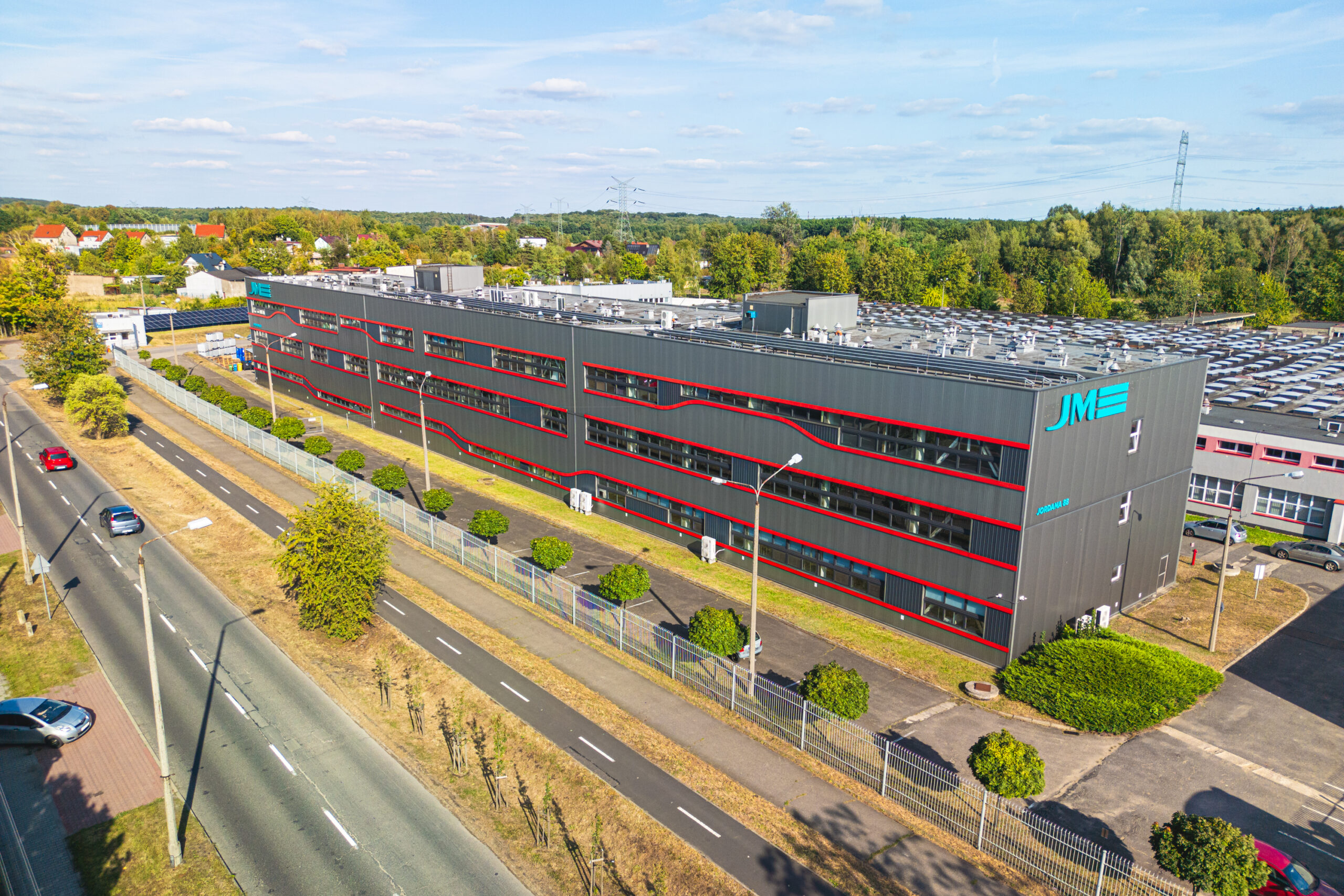
- Access to a global supply chain: : An experienced EMS provider purchases components at a significantly larger scale than a single OEM and understands the supplier market inside out. In times of semiconductor shortages and component allocation, the EMS provider’s purchasing power becomes your insurance policy. One of the pillars of JM elektronik’s business for more than 35 years has been electronic component distribution. The relationships built and maintained over decades, combined with deep market expertise, enable rapid and efficient identification of substitute components when availability problems occur.
- Direct access to process engineers: In a partnership with an agile EMS provider, decisions happen immediately. Without a multilayered corporate structure, technical process optimization or documentation updates (Gerber files, BOMs) do not require endless approval chains. Procedures remain lean, and decision-making authority stays in the hands of specialized engineering teams.
- Structured process knowledge: Ongoing cooperation with external EMS engineering teams enforces rigorous documentation standards. This eliminates the “human factor” problem – situations where critical PCB assembly knowledge exists only inside the heads of a few employees on the factory floor.
For mid-sized OEM manufacturers with their own production capabilities, relying on a global EMS corporation can create a serious risk of project marginalization during component shortages or market disruptions.
An agile partner operating an advanced manufacturing facility in Poland offers direct access to decision-makers, operational flexibility, and guaranteed dedicated production slots secured under a Business Continuity Plan (BCP) agreement.
Maintaining an internal machine park makes sense for rapid prototyping or short-run niche production. However, building walls around your factory and avoiding long-term cooperation with an EMS provider during a period of severe European market turbulence means giving up one of the most important operational safety buffers available today.
Integrating a trusted EMS provider into your permanent manufacturing architecture is not a cost – it is an investment in operational stability. It allows companies to transform part of their high fixed costs into predictable variable costs while reducing exposure to sudden internal risks.
Does Diversifying Electronics Manufacturing into a Hybrid Model (In-House + EMS) Increase Operating Costs?
In the short term, unit costs at an EMS provider may be comparable to – or slightly higher than – the direct cost of internal manufacturing.
However, when analyzing total cost of ownership (TCO) and overall operational risk, maintaining a “live,” active manufacturing alternative drastically reduces potential losses caused by downtime, contractual penalties, or permanent market share erosion resulting from product shortages.
Want to Find Out How Much You Could Save by Implementing a Hybrid In-House + EMS Model? Feel free to contact us.